Lecture 2 What Are Information Systems?
In This Lecture You Will Learn:
- Information & Information System
- Types of IS
- Information Technology
- Strategy & planning for IS
- Strategies for success
Information & Information System
- Identifying ways that an information system can support the purposes of a human activity system.
- IS has become a multidisciplinary subject that bridges many other field. e.g. computer science, business management, psychology, philosophy.
Information
- Conveyed by messages and has meaning.
- Meaning always depends on the perspective of the person who receives a message
- We are always surrounded by a vast mass of potential info, but only some of this ever comes to our attention, and only some of that is actually meaningful in our present context.
Data (from the Latin for ‘given’)
- This is a fact, but one that has not been selected for attention.
Capta (from the Latin for ‘taken’)
- A fact that has been selected for attention.
Information
- It has meaning within the context.
Knowledge
- Being structured into more complex meaning related by a context.
- Knows what to do.
Information System
- Information Constructed to help people in a human activity system to achieve their goals.
- The following is intended to introduce some aspects of the role of information system, rather than to depict the actual system.
- Operational system
- Management support system
- Real-time control systems
Operational System
- Automate the routine, day-to-day record keeping tasks in an organization.
- Repetitive tasks that involve little judgement in their execution are the easiest to automate.
- Organization to keep track of money
Management Support System
- To support management work at a much higher level of complexity.
- Much of the information used by management to make decisions.
- Crucial aspect of MSS is the feedback or feed-forward that it provides, alerting managers to problems and opportunities, and assisting them in the process of tuning the organization’s performance.
- Operational systems are located in the central box (labeled ‘what the system does?’) – supporting work of I/O.
- Management support systems are located in the lower part (labeled ‘control unit’) – support the flow of feedback to, or control information from, the control unit.
Real-time Control System
- Explicitly concerned with the direct control of a system’s operations, often physical in nature. e.g. lift control systems, aircraft guidance systems.
- Best considered as a control sub-system of a physical processing system.
- Usually have human operators, but they are generally insulated from the surrounding human activity system.
Information Technology
- Decisions about IT should ideally be made last in the cycle of development.
- Only when the human activity system has been understood, the need for an IS has been identified, and the IS requirements have been defined – only then should emphasis turn to the IT that will implement it.
- Varieties of hardware, a computer or its peripheral devices.
- Software
- Telecommunication technology
Types of IS
- Information Systems are used to support people’s activities
- Store and retrieve information
- Carry out calculations
- Aid communication
- Control and schedule work
- Provide other support?
- Operational Systems assist or control business operations
- An Accounting System replaces costly and error-prone human clerks
- Management Support Systems help managers to decide or to communicate
- A Market Intelligence System helps decide where to site a new retail store
- Real-time Control Systems typically operate physical equipment, often in safety-critical settings
- Some cars have an Engine Management System to control fuel supply and ignition
How Do IS Relate to the Human Activity System?
- We can view an organization as a system, perhaps with many sub-systems
- Ideally, each sub-system helps the overall system fulfil its purpose
- IS are also sub-systems and should help to meet goals of people in the organization
Strategy and Planning for IS
Strategies for Success
- All info SAD projects begin with the identification of a business issue that can be aided or a problem that can be solved by the use of an IS.
- The underlying assumption is that IS are only worthwhile if they meet the needs of the organization in which they are installed.
- Identifying a business strategy
- The contribution of IS
- Information systems and information technology strategies
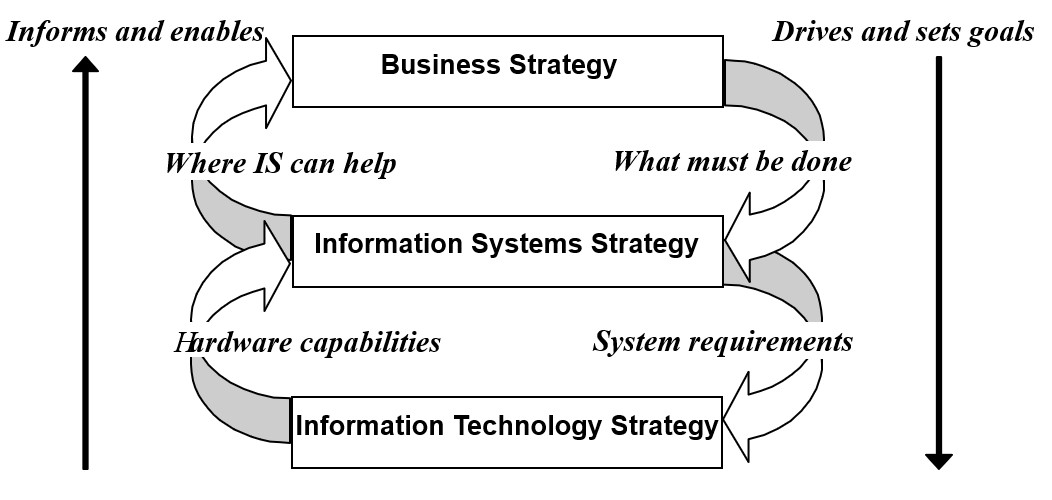
- Thus, the business strategy drives the IS strategy, which in turn drives the IT strategy.
- Info flows in the diagram are not only in one direction.
- To be advised on those area of the business where IS can contribute to fulfilling business goals. Thus the planning cycle is iterative.
- A similar two-way communication takes place between the IS and IT strategy planning functions.
- The role of the IT strategy is to enable the successful implementation of the systems defined in the IS strategy, while also informing the IS strategists about what is feasible.
Identifying a Business Strategy
- Where would we like our organization to be in (say) ten years’ time?
- How do we get from where we are not to where we want to be?
- How do we meet those business goals?
- SWOT analysis
- Detailed contents of any particular strategy depend very much on the characteristics of the organization, its environment, the skills of its workforce, and many other factors.
The contribution of IS
- To the achievement of business goals in so many different ways that it can seem daunting to decide which are the systems that really matter.
- Porter’s Value Chain Model (1985)
- Depicts an end-to-end ‘chain’ or flow of materials through the organization.
IS & IT Strategies
- Best managed organizations separate their strategic thinking into the three layers.
- Key idea – the development of new IS should only be considered in the context of a well-though-out business strategy, while purchases of IT hardware should be considered in the context of specific IS that are planned for development.
Summary
In this lecture you have learned about:
- What is Information & IS
- Three types of IS
- What is IT
- The strategy & planning for IS
- The strategies for success