Chapter 1 Service and Processes
Introduction
- When setting up a service organization, a series of paradigm can be used which are widely acceptable in the market.
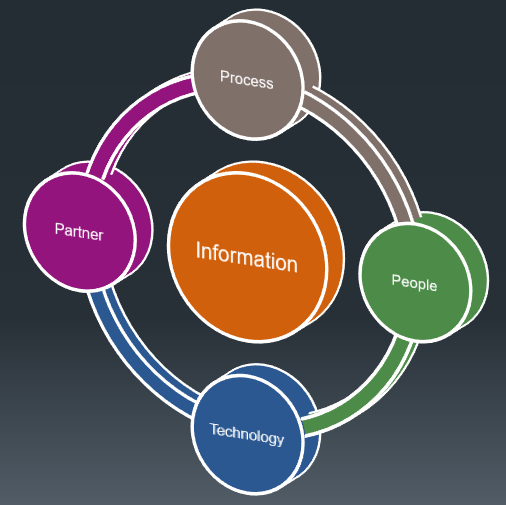
- PPTP – Process, People, Technology and Partner
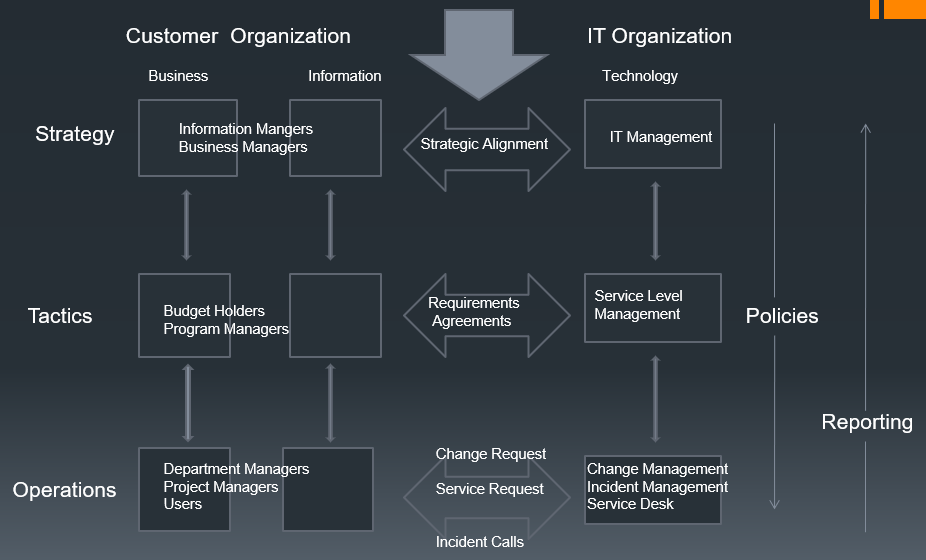
- Customer-Provider Paradigm
- SOD – Separation of Duty
- To be in control
- Management Paradigm
- All activities of an organization are managed from a specific perspectives
- The 3X3 Matrix for Information Support
- Combination of Separation of Duty paradigm with Management Paradigm
PPTP
We need to address ALL of these elements in the organization, to make sure we reach an optimal information result.
PPTP - Process
- Refers to what the organization does, in terms of the structured sets of activities.
- Relate directly to the:
- Identify of the organization and its products or services.
- What is the core business of the organization.
- What is its market.
- What does the organization to do to be in business.
- The description of the process will define the business it is in: insurance industry, education industry and etc.
- A good organization will have well defined processes and in control in managing these processes.
- Processes from the same industry will be almost similar.
- This is so in IT service organizations
PPTP - People
- Refers to the organization specifications i.e who does what.
- The distribution of responsibilities and authorization over the staff and teams
- What skills and competencies are necessary?
- What are the local cultural and behavioral standards and policies to be used?
- Process depends on people
- There are more variability on people than on processes
- People dimension is highly influenced by culture, manager, law, financial strength
PPTP - Technology
- If we know what we need to do (process) and who is to do it (people) we now need the infrastructure and the tools, the methods and techniques to reach an optimal result
- A carpenter is as good as his tools: without good equipment we cannot deliver high performance.
- A fool with good tools is still a fool
- We need to be able to understand the process and how technology is used to achieve the objectives
- IS and IT knowledge is essential in this case
PPTP - Partners
- Related to the ‘sourcing’ strategy in an organization. The strategy is based on ‘make or buy’, achieving the right mix
- Its impossible to work without some external providers hence this domain is important
- Information – this is the actual target for this paradigm
- Information is based on data that are handled in the processes by people using the technology
- Users utilise the data and add value by combining and processing them, creating meaningful information to be used in business process.
Customer – Provider Paradigm
- IT services are basically considered to be providers of IT service and have one or more customers
- To support a clear and manageable relationship, both parties should agree on the SMART specification of the services
- The agreed services are based on customer requirements and is limited by the providers capacity, capability and availability to provide the service
- The provider on his turn is the customer for his sub-provider, who is customer for the sub-sub-provider
SMART
- Specific – Services required must be specific
- Measurable – Outcomes must be measurable
- Achievable – Outcome must be doable or achievable
- Realistic – Requirements must be realistic or relevant to the business
- Timely – Services requested must be time bound
SoD – Separation of Duties
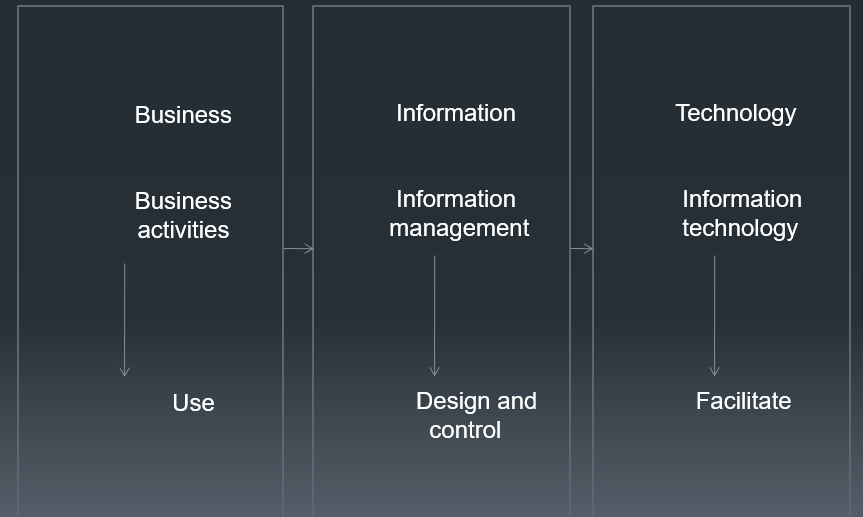
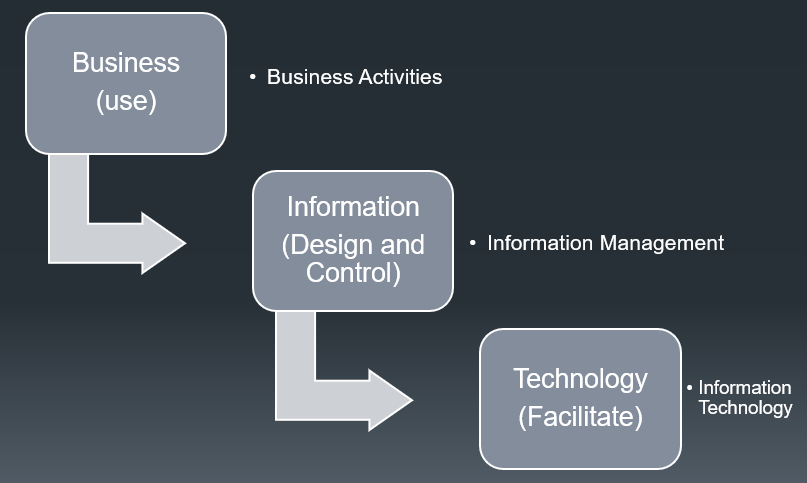
- An organization should distinguish between setting goals and realizing them
- It should be managed by separate domains to prevent conflicting interest
- Business – the requirement and use of activities to support the business
- Information – the design and control of the acquiring of information
- Technology – the use of IT to facilitate the outcome
The Customer – Provider Paradigm
The Management Paradigm
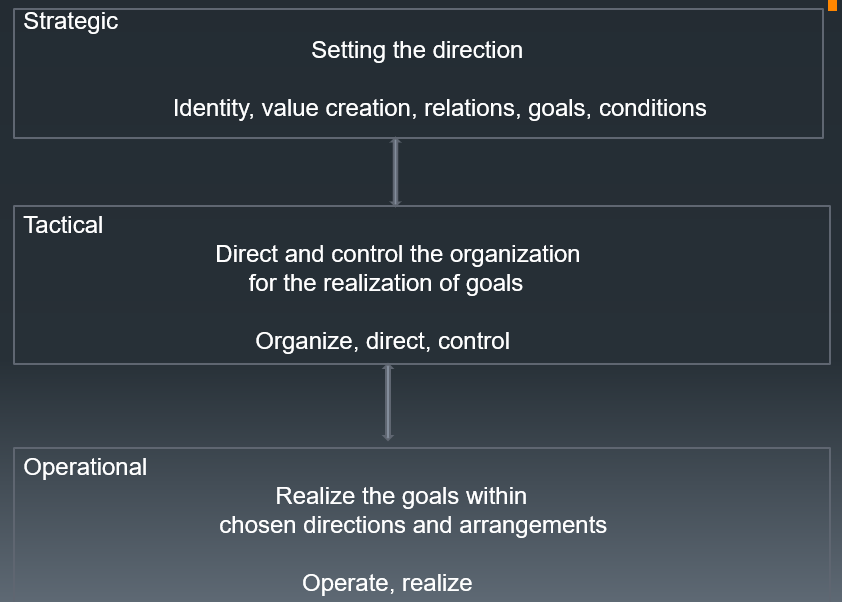
- The management of activities in an organization can be managed in the following perspective
- Strategic – long term goals, setting directions
- Tactical – mid term objectives, design and control
- Operational – short term achievements, realization
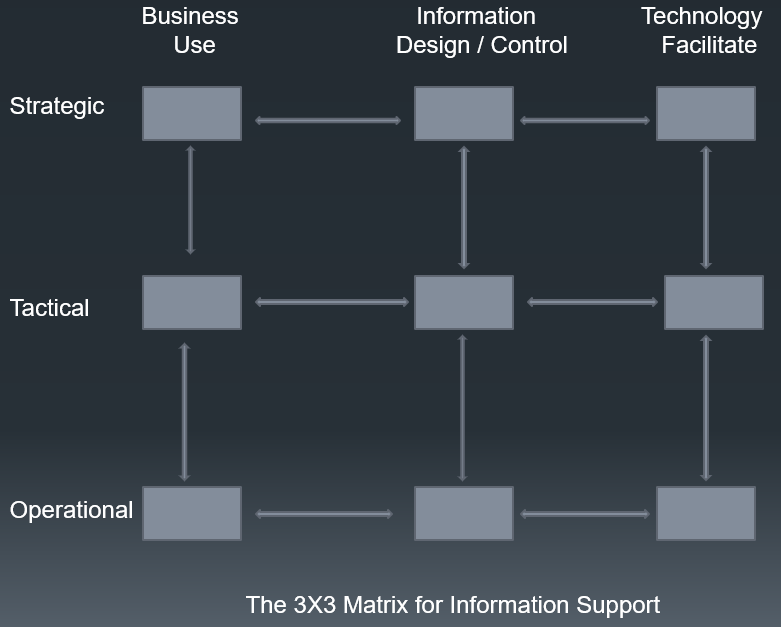
The 3X3 Matrix for Information Support
- Stuck in the middle – Information management is positioned at equal distance from the Business and Information Technology domain
- Organization trying to implement Information Management as a liaison function
- Information Management will be an independent “Demand Organization” loosely coupled with the Business
- An extension of the IT function – The Information Management responsibilities delegated to the Technology domain
- This is not recommended as it tends to be expressing itself in terms of technology not in terms of business values
- Information service provider is controlling itself, which leaves the Business vulnerable in its relationship with suppliers
- Information Management is set at a distance resulting in misalignment between Technology and the Business
- An extension of the Business function – Information is considered to be a business asset
- Relationship with Technology is a contractual one
- IT is a supportive function, to be managed as such and governed via outsourcing
- Information Management and Business responsibilities are tightly bound and IT can be regarded as a replaceable commodity provided by adequate supplier
Management of Processes
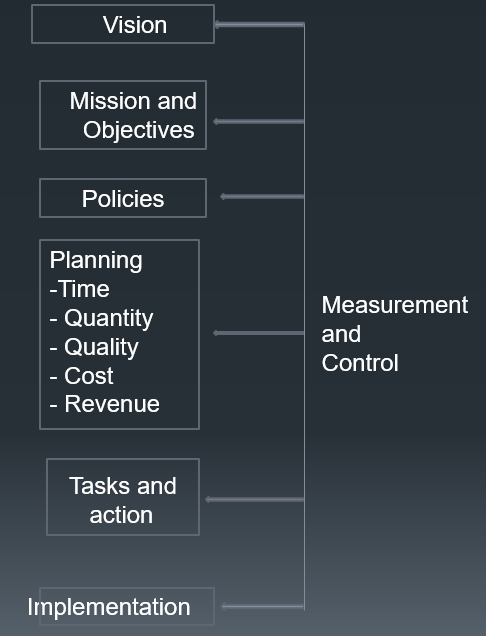
- Every organization aims to realize its vision , mission, strategy, objectives and policies which means that appropriate activities have to be undertaken
- For example a restaurant will have to purchase fresh ingredients, the chefs will have to work together to provide consistent food, etc
- In this example activities include buying fresh food, bookkeeping, publicity, receiving guests, cleaning etc
Processes
- Processes are group of activities
- What has to be done
- What the expected inputs and results are
- How we measure whether the processes deliver the expected results
- How the results of one process affect those of another process
- A Process is a structured set of activities designed to accomplish a defined objective
Process Diagram, based on the ITOCO Model
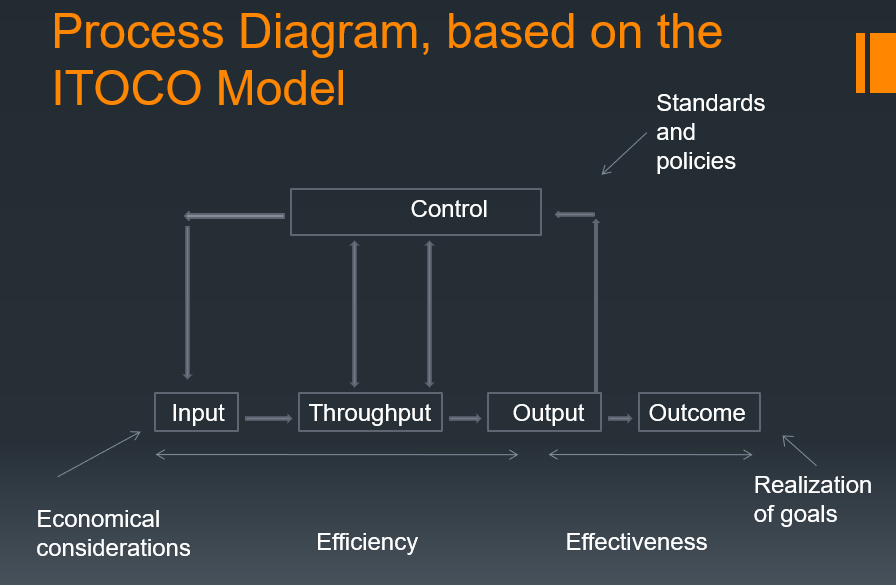
The ITOCO Model
- ITOCO – Input-Throughput-Output-Control-Outcome
- Input – the resources being used in the process
- Output – immediate results of the process
- Outcome – long-term results of the process
- Throughput – control regulates the input and the throughput in case the throughput or output parameters are not compliant with the standards and policies
- Output – describes the immediate results of the process
- Outcome – indicates the long term results of the process in terms of meaningful effect
- Control – activities associated with the input and output of each of the processes with policies and standards to provide information about the results to be obtained by the process. Control regulates the input and the throughput
Procedures and Work Instructions
- A procedure is a specified way to carry out an activity or a process
- A procedure describes the ‘how’ and can also describe ‘who’ carries the activities out.
- A procedure may include stages from different processes
- A set of work instructions defines how one or more activities in a procedure should be carried out in detail using technology or other resources
IT Services
- Services are highly intangible
- Not tangible, cannot touch, only tangibles are hardware and the network
- Services are produced and consumed at the same time
- Services cannot be stored, consumed the moment it is provided
- Services are variable
- Provided by people which is variable, has moods
- User takes part in the service
- User has an influence in the quality of the service
- Satisfaction is subjective
- Service can only be measured hence judged only after delivery
Components of IT Service
- An IT service is a service provided to one or more customers by an IT service provider. An IT service is based on the use of IT and supports the customer’s business processes. An IT service is made up from the combination of people, process and technology and should be defined in a Service Level Agreement.
- In terms of technical composition, an IT service is a supported Information System that is delivered to a customer against an agreed quality
Information System ( IS )
- The Information System is the entirety of components that are required and used to compose the information processing system.
- It breaks into three main parts of the PPTPI set: People, Process and Technology. This can be used with Partners to manage the final focus area, Information
- People – part of the IT service are the staff that should be in place to make sure that the IS works accordingly as required
- Process – required procedures, the instructions, the manuals etc all documented
- Technology – most familiar to IT people, broken up into applications that runs on Systems in certain Environments. Can be broken further to hardware, system software, networks, middleware, application software and database
Quality
- Quality is the ability of a set of inherent characteristics of a product, system or process to fulfill requirements of customers and other interested parties.
- A specific characteristic of a service that satisfy the customer’s expectations
- “Conformance to Requirements”
- Behavioral aspects like response time or physical characteristics like a processing function
Attributes of Quality
- Availability – IS being available for the user at an agreed time and place
- Performance – speed at which processing is done, user experiences the ‘consolidated output’ of the performances of all components
- Capacity – the amount of some characteristics like disk storage, CPU etc
- Security – covered in most agreements
- Confidentiality – an element of security, can be of importance depending on the business
- Scalability – ensure growth at the required speed without disturbing the business
- Adjustability – development methods, infrastructure architecture must support the adjustability of an IS
- Portability – maybe be important to change providers frequently
Vision, Objectives and Policies
- Mission statement – a short, clear description of the objectives of the organization and the values it believes on
- Strategy – the plan to achieve defined objectives
- Objectives – describe what the organization wants to accomplish is detail
- SMART
- Specific
- Measurable
- Achievable, Appropriate
- Realistic, Relevant
- Timely, Time bound
- Policy – the combination of all decisions and measures taken to define and realize the objectives. Prioritize objectives and decide how they can be reached.
- Planning – divided into stages to provide milestones where progress can be monitored
- Action – activity schedule, required resources quality
- Tasks – actions are allocated to personnel as tasks or outsource to external organizations
Measurements
- At regular baseline, the mission must be measured
- Balanced Scorecard(BSC) – objectives are used to define Critical Success Factors(CSF)
- CSF – defined for a number of areas of interest or perspectives like customer/market, business processes, personnel and finance
- Key Performance Indicators(KPI) – parameters for measuring progress relative to key objectives or CSF in the organization
Vision, Objectives and Policies
Planning Horizon IT Department
- Technical infrastructure – longest planning horizon. Information systems and business depend on this, limit the speed at which changes can be implemented
- Applications – designed for specific business purposes. Lifecycle planning based on business functions
- Business plans – based on regular planning cycles and is takes the shortest time in this horizon, over one calendar year
Business Plan Elements
- Time – defined by the start and end date and is often divided into stages
- Quantity – objectives have to be measurable to monitor progress, ‘improved’ and ‘quicker’ are insufficient for planning purposes
- Quality – of the deliverables should be appropriate for the objectives
- Finance – deliverables must be proportion to the expected costs, efforts and revenues
Business Relationship Management
Communication
- Reporting – internal and external reporting aimed at management, customers, project progress, alerts
- Meetings – project meetings, regular meetings with specific targets
- Online facilities – email, chatrooms, groupware, messenger, teleconferencing
- Notice boards – near the coffee maker, entrance to building, company restaurant
Types of Communication
- Routine operational communication
- Communication between teams
- Performance Reports
- Communication during projects
- Communications when there are changes
- Exceptions and emergencies communications
- Training for new and adapted processes
- Communication with service production teams regarding service strategies and design